Historically, Pueblos have worked with traditional, locally sourced clays, slips, and pigments to create pottery. Nontraditional paints and paper were uncommon until engagement with the outside world became more widespread, and even then, it was unusual for women to work with these materials. Painting on paper, along with traditional pottery, was given a monetary value by outsiders as the economy in New Mexico shifted from barter to cash. In the early-to-mid-20th-century, a new Pueblo painting tradition — spurred by external influences — was developing, and a few Pueblo women stood out, both for their talent and rarity.
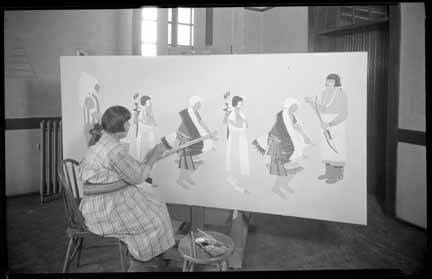
In the early 1930s, Santa Fe Indian School (SFIS) implemented a federally run art program that became known as “the studio” to formally train Native students in the arts and crafts of their communities in the hopes of preserving these traditions, as well as boosting the economic prospects of each prospective artist. Although the program was the brainchild of outsiders, it offered Native students an outlet for soothing their homesickness, allowing them to connect to their cultures through art. These paintings are now an invaluable visual record, offering contemporary Pueblo people a glimpse into traditional lifeways that we still maintain over a century later.
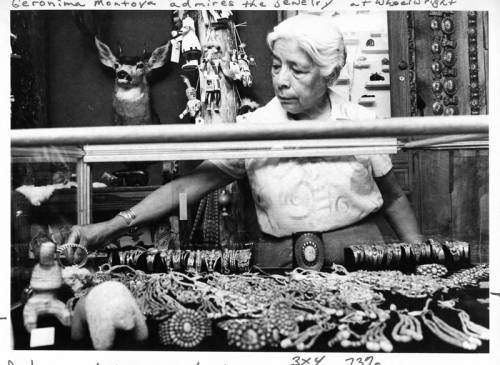
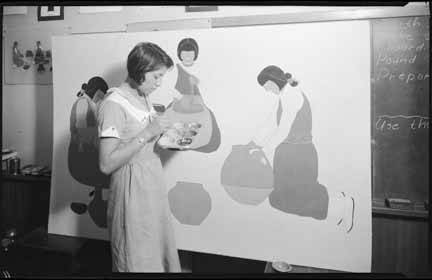
Gerónima “Jerry” Cruz Montoya/ P’otstúnú (1915–2015) from Ohkay Owingeh was one of the earliest students of the SFIS art studio, a program that she would eventually head. P’otstúnú was one of five daughters born to Pablo and Crucita Cruz. Her father was a farmer, and her mother. a well-known potter. Montoya was inspired to become a painter while studying with art teacher and program head, Dorothy Dunn, who acted as a mentor to the developing artist. After graduating from high school, Montoya became Dunn’s assistant, and led the program when Dunn left. In this position, Montoya impacted countless Native students during the 23 years she taught at SFIS. According to one Pueblo elder, a student who attended the school in the 1950s, her classes were popular because they offered a way for students to express their “Pueblo-ness” when other areas of the culture, such as language, were off-limits; and they also provided an immediate source of income for students who were able to sell their paintings.[i]
Montoya’s art and philosophy reflected the conventions of the studio program; paintings were highly detailed depictions of traditional dances, and occasionally, daily village activities, and the natural world (namely animals) all situated against a plain or “flat” background. About art grounded in indigenous identity, Montoya said:
Indians sense the creative forces still alive behind each created object. They are aware that happiness, inspiration, and purpose in life depend on an inner awakening, call it spiritual if you like. Indians work with nature, not against it. Indians try to understand the natural forces and work within them.
After leaving SFIS, Montoya headed up adult education — which included arts and crafts classes, and other practical classes — at Ohkay Owingeh, and in 1968, she founded the Oke Oweenge Crafts Cooperative (an organization dedicated to marketing student artwork).
In addition to raising two sons (who also became painters), she was active in the Pueblo’s Catholic church, where she sang in the Tewa language choir. In 2004, the Santa Fe Living Treasures program named her a Living Treasure, and in 2010, the Southwestern Association of Indian Arts honored her with a lifetime achievement award.
A predecessor to Montoya in the world of painting was Tonita Peña/Quah Ah (1893–1949). Quah Ah was born into a family of potters in 1893, in San Ildefonso Pueblo, a Tewa-speaking village. In 1905, her mother and younger sister died from influenza, and her father moved the 12-year-old girl on a multiday wagon trip south to Keresan-speaking Cochiti to live with her aunt and uncle, who had moved there a few years earlier.
Prior to the move, Peña was introduced to Western-style art by her San Ildefonso Day School teacher, Esther B. Hoyt, who prompted her, along with other students, to paint what they saw in their community, including traditional dances. Hoyt bought some of Peña’s first watercolor paintings. Several other talented “self-taught” painters from San Ildefonso also emerged with Hoyt’s support, but Peña was the only woman; this group of painters established a new painting tradition, which, in turn, led to the creation of the SFIS studio. While in San Ildefonso, Peña met Edgar L. Hewett, an archaeologist and anthropologist who founded the School of American Research in Santa Fe; he encouraged her to paint and supplied her with watercolor paints and paper.
Peña married young and had her first child soon thereafter, with several children to follow[ii]. She helped support her family with her watercolor paintings. She was among several other Native artists whose work was exhibited on behalf of the United States at the 1932 Venice Biennial, which was then, the most prestigious international exhibition of contemporary art. The Whitney American Museum purchased her Biennial painting at a price said to be the highest ever paid for a Pueblo Indian painting at the time. Peña, along with several male counterparts, painted a series of murals at SFIS under the Works Progress Administration (WPA). Peña’s son, Joe H. Herrera, became a notable painter.
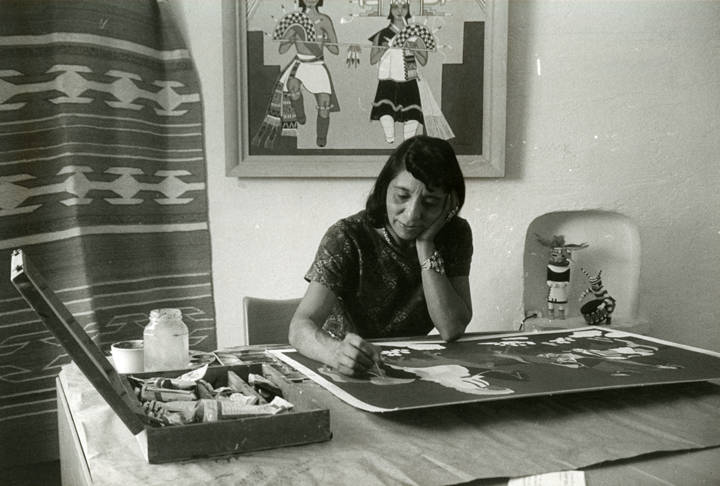
Like Peña, painter Pablita Velarde/Tse Tsan (1918–2006) lost her mother at a young age; she was about five years old. Tse Tsan was born in Santa Clara Pueblo. Two years afterher mother’s death, she was sent to St. Catherine’s Indian School in Santa Fe and then to SFIS, where she worked with Dunn, painting what she called “memory paintings” or documentations of life in her village. While there, she befriended Peña, who was there working on the WPA murals. According to Velarde, Peña played an important role in her wanting to become a painter.
During the early years, Velarde painted with watercolors, and later with natural pigments made from minerals and rocks that she ground herself to produce “earth paintings.” According to Velarde, “Painting became my life. I ate, breathed and dreamed painting.” It became her life so much so that she was able to support her two children.
In 1939, she was commissioned by the National Park Service as part of the WPA to paint scenes of Pueblo life at Bandelier National Monument. In 1954, the French government honored her with the Palmes Académiques for excellence in the arts. In 1977, she received the New Mexico Governors Award, and in 1990 received a Lifetime Achievement Award from the National Women’s Caucus for Art. She also authored and illustrated a children’s book titled, Oldman Storyteller. Helen Hardin (Velarde’s daughter), Margarete Bagshaw (Velarde’s granddaughter), Helen Tindel (Velarde’s great-granddaughter) all became painters, carrying on the matriarch’s legacy.
Montoya, Peña, and Velarde were often the only female students in their art class, or the only woman on an art project. Although each was deemed successful by the outside world as measured by the accolades they received or the prices paid for their art, their legacies as visual documentarians, preservationists of Pueblo culture, and caretakers of families, are immeasurable in the places that they came from.
Sources Used
Brody, J.J. Pueblo Indian Painting: Tradition and Modernism in New Mexico, 1900—1930, Santa Fe, N.Mex.: School of American Research Press, 1997.
Gray, Samuel L. Tonita Peña. Albuquerque: Avanyu Publishing Inc., 1990.
Ruch, Marcella J., Pablita Velarde: Painting Her People. Santa Fe: New Mexico Magazine, 2001.
Shutes, Jeanne and Jill Mellick, The Worlds of P’otstúnú: Geronima Cruz Montoya of San Juan Pueblo. Albuquerque: University of New Mexico Press, 1997.