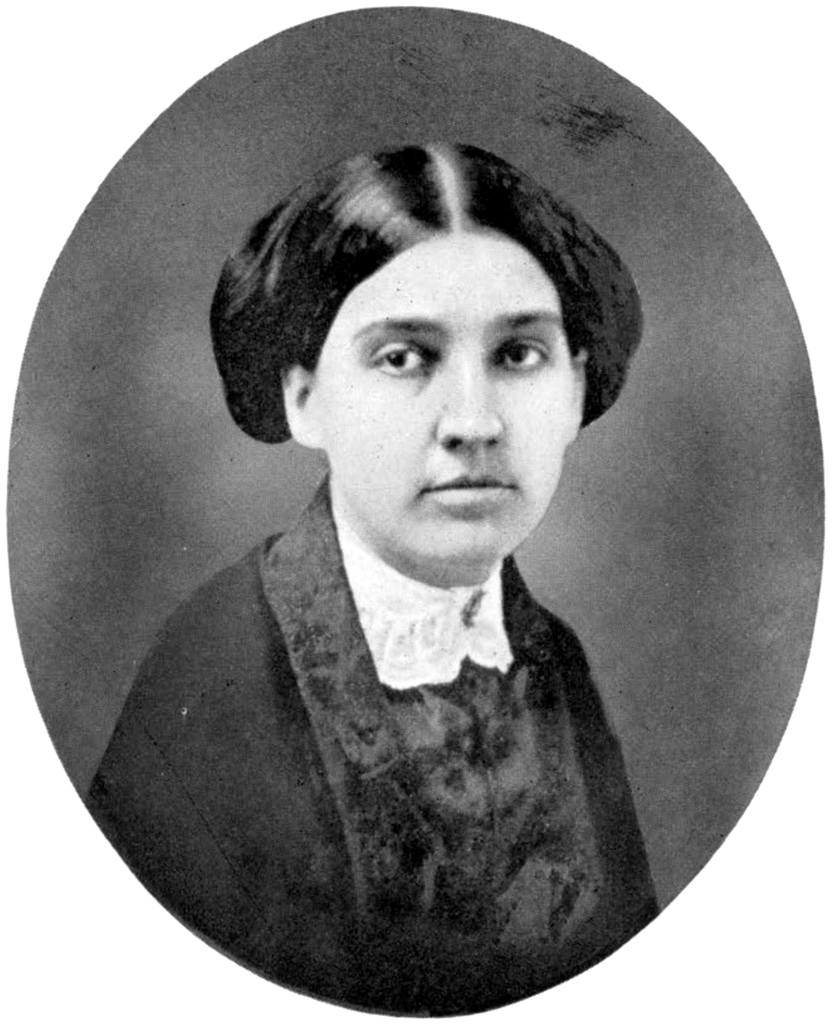
“When I look around me and find myself alone, I sigh for you again; little sigh, and vain sigh, which will not bring you home. I need you more and more, and the great world grows wider….” It’s no challenge to sense Emily Dickinson’s yearning in these words, which were directed to Susan Huntington Gilbert, the woman who would become her sister-in-law.
In the same letter, written in 1852, Dickinson goes on: “Susie, forgive me Darling, for every word I say—my heart is full of you, none other than you in my thoughts, yet when I seek to say to you something not for the world, words fail me; If you were here, and Oh that you were, my Susie, we need not talk at all, our eyes would whisper for us, and your hand fast in mine, we would not ask for language….”[1]
Researchers have speculated whether the relationship between Dickinson and Gilbert was indeed romantic. What we know for certain is that Dickinson and Gilbert met in 1850, when they were both around the age of 20, and until Dickinson’s death in 1886 at the age of 55, Gilbert remained Dickinson’s editor, reader, muse, and, as Maria Popova writes, “her fiercest lifelong attachment.”[2] In the book Open Me Carefully: Emily Dickinson’s Intimate Letters to Susan Huntington Dickinson, nearly 250 letters and poems—along with a number of notes Gilbert wrote to Dickinson—seem to prove that what the two women had was far more than friendship.
During those same years, Dickinson’s brother, Austin, also yearned for Gilbert. The feelings must have been mutual, at least to some degree, because in 1856, Gilbert married Austin. Was Gilbert truly in love with Austin? Could she have genuinely been in love with both Dickinson siblings? Did Austin know about his sister’s feelings? Did the reality of social pressure and expectations around heteronormative relationships force Gilbert’s decision? The couple moved into a new house built just for them from across the Dickinson estate, in which Emily continued to live. At least now only a lawn away, the two women continued to see each other.
Emily Dickinson never married and never had children, though she may have also been romantically linked with men including Judge Otis Phillips Lord[3] and women such as fellow poet Kate Scott Turner Anthon.[4] Using letters and poetry as vehicles for her innermost emotions, her writing strategically expressed her desires. Though she wrote her letters surely with the intention of privacy, there was always some risk they could be discovered, which could invite a long list of devastating consequences. Such risk arguably encouraged more creative language—her words and phrases play with layers of meaning where nothing is too explicit or direct. Dickinson’s poems, on the other hand, were surely written with the intention of being discovered—and yet during her lifetime, only 10 of them were published, though all were published without attribution.[5] The majority—nearly 1,800—were published after her death. Her family discovered these poems, along with other content, and some of these works may have been censored, revised, or even destroyed. [6]
Still, the need to create, to express, and to connect surpassed any risk Dickinson may have felt. Many other authors have also felt this way, using letters in particular as a way to say what they need to say to the person they love, consequences be damned. Written passionately (see: Anaïs Nin and Henry Miller), playfully (see: Virginia Woolf and Vita Sackville-West) and even downright lasciviously (see: James Joyce and Nora Barnacle), such letters shine light on some of our deepest inner workings as human beings, the ways in which we wish for, process, analyze, feel, understand, and suffer.
And what of letters that did get destroyed, or ones that we can only imagine ever existed? New Mexican author Nancy Foley grappled with this question in her recently published novel I Am Agatha, which reimagines what life might have been like for queer painter Agnes Martin while living in Mesa Portales, New Mexico in the 1970s. Foley’s grandmother had told her of letters written between Martin and her grandmother’s friend, who lived in the area, letters that were destroyed by the friend’s son after she passed away. “Even after my grandmother died a few years later, something in me resisted tracking down the letter-burning son. …I understood it was the mystery of the story that I loved, and for a long time I mostly kept it to myself,” Foley says. Through the fictional characters Agatha and her love interest Alice, Foley has breathed new, poetic life into some real experience Martin may have actually had.
Dickinson continued to write to and for Gilbert, up until her death. And Gilbert continued to respond, if only in the format of an inscription. As Maria Popova writes, “Thirty years into the relationship, Susan [gave] Emily a book for Christmas—Disraeli’s romance novel Endymion, titled after the famous Keats poem that begins with the line ‘A thing of beauty is a joy for ever’—inscribed to ‘Emily, Whom not seeing, I still love.’”
In this modern time, saturated by AI, social media, dating fatigue, and more, perhaps, again, we have to look to the poets for inspiration—to remember how to feel, and to be courageous. Especially in this contemporary context, is there anything more rebellious, refreshing, and romantic than an actual, physical, human-written letter expressing genuine desire and emotion? And if we get tongue-tied or perhaps a little shy, we can always look to examples—with plenty to choose from by Emily Dickinson alone—and borrow a quote or two.
[1] https://archive.emilydickinson.org/working/hl2.htm
[2] Popova, Maria, “Emily Dickinson’s Electric Love Letters to Susan Gilbert.” The Marginalian, https://www.themarginalian.org/2018/12/10/emily-dickinson-love-letters-susan-gilbert/
[3] “Emily Dickinson’s Love Life.” Emily Dickinson Museum, https://www.emilydickinsonmuseum.org/emily-dickinson/biography/special-topics/emily-dickinsons-love-life/
[4] Enszer, Julie, “Is This A Photo of Emily Dickinson And Will It Tell Us Who She Loved?” Ms. Magazine, https://msmagazine.com/2012/09/11/is-this-a-photo-of-emily-dickinson-and-will-it-tell-us-who-she-loved/
[5] “Publications in Dickinson’s Lifetime,” Emily Dickinson Museum, https://www.emilydickinsonmuseum.org/emily-dickinson/poetry/the-poet-at-work/publications-in-dickinsons-lifetime/
[6] Ackmann, Martha. Review of Open Me Carefully: Emily Dickinson’s Intimate Letters to Susan Huntington Dickinson. The Emily Dickinson Journal 8, no. 2 (1999): 111–113. https://dx.doi.org/10.1353/edj.1999.0013.