EXPLORING ALDO and ESTELLA’S QUERENCIA
We recognize that many recent querencia observations in New Mexico literature, memoirs, and scholarship have not been associated with Aldo’s work. Some commentators have attributed the exclusion of Hispanic culture recognition to political forces of colonialism and racism.
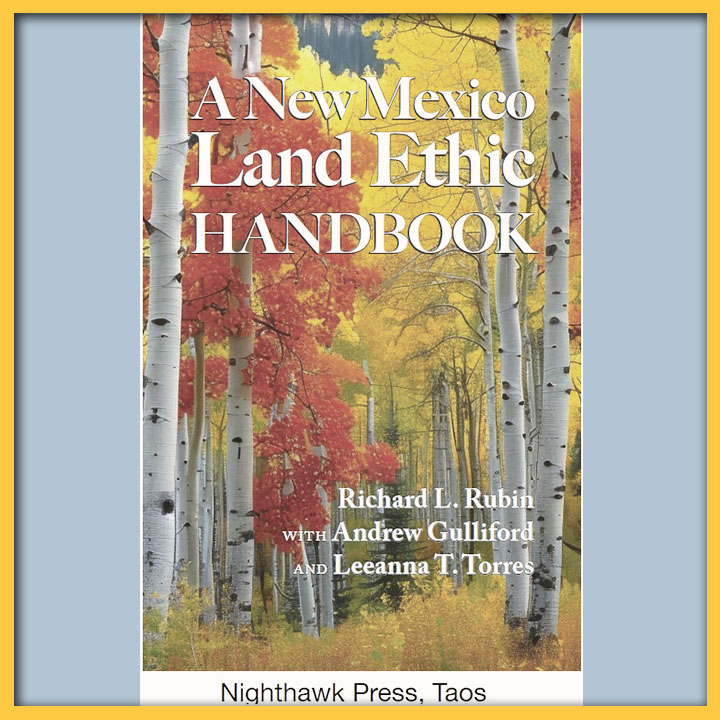
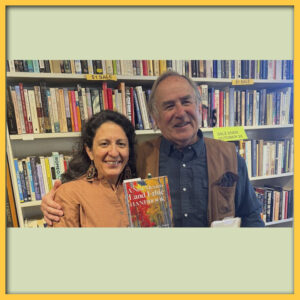
Cover of A New Mexico Land Ethic Handbook.
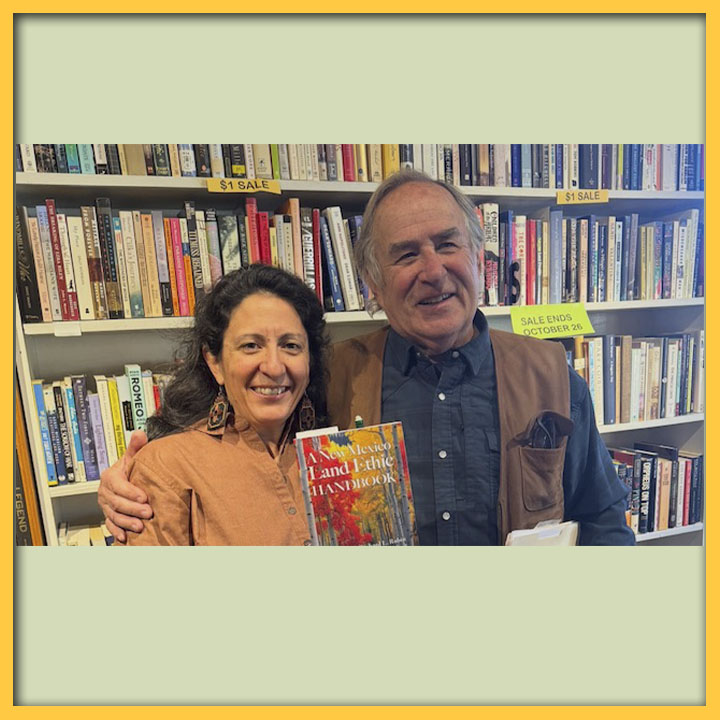
Photo Courtesy Leeanna Torres
SHARE:
Richard L. Rubin (Arroyo Seco, NM), Leeanna Torres (Tomé, NM) & agradecimientos for Ernie Atencio (contributions).
Exploring Aldo and Estella’s Querencia
Listen to the longing of the nostalgic Mexican folk song, “Cuatro Milpas”, its lyrics describing a beautiful ranch now in ruin, the voice singing “ay, ay, ay” as a repeated longing as it accompanies a strumming acoustic guitar….[1]
We are curious about Estella Leopold and her family’s influence on Aldo’s philosophy from the New Mexico tradition of querencia. Esteemed author Rudolpho Anaya wrote: “Querencia is love of home, love of place. That is the love I felt for our humble home…. We live in a big country, but we also live in the smaller patria chica that contains the villages of the vicinity, los vecinos. .. I share some of my personal journey with you fully realizing that each one of you has a different history of home and querencia, which leads me to believe that one can make querencia wherever one lives…Your spiritual quest can make querencia.”[2] While Estella descended from New Spain conquistador nobility, Norteño conservationist and anthropologist Ernie Atencio offers that she “may not have been part of that poor, dirt-farming culture that my ancestors came from, but she certainly would have been exposed to those traditions and beliefs, and we all know how strong an influence our spouses can be, whether we realize it at the time or not”.[3] Our ecological consciousness is influenced by Richard’s several years immersion in the teachings of Aldo Leopold while volunteer steward at the historic home on the Carson National Forest. Leeanna’s Nuevo Mexicana heritage was deeply informed by the tradition of querencia. This essay explores querencia in New Mexico during Aldo and Estella’s life together here. We express our intuition and insights about the evolving traditions of relationship to land from the historic Spanish royal grants, through Hispanic settler culture, to the U.S. government hegemony.
What relationship to land might Estella have derived from her family heritage? A recent memoir by daughter Estella Leopold Jr.,[4] youngest of the five children, describes that her mother Estella’s New Mexico history began with an enterprising Spanish naval captain during the long conflict with Moorish occupation of the Iberian Peninsula. In 1091, he attacked an enemy fleet, not by the usual practice at dawn, but by the light of the moon. When victorious, the king was impressed and bestowed the honorary name of de Luna with attendant prestige and social promotion. Subsequent generations were among the nobility and military leaders. After the Castille y Leon led Reconquista expelled the Moors in 1492, Luna family officers joined Cortez and Coronado expeditions to Nuevo España.
Due to oppression of the Puebloans, the early settlers in New Spain were killed or driven down to El Paso in the Pueblo Revolt of 1680. Yet Spain pursued a successful Reconquista here in 1693. Nobility and military officers were then awarded royal land grants. In 1716, Diego Luna bought the entire million acres of the San Clemente Grant in the Rio Abajo region south of present-day Albuquerque. The next significant event occurred in 1850. Related by marriage, Antonio Jose Luna and Antonio Jose Otero drove 50,000 sheep to California, selling to the gold miners at a good profit. As the Rico wealthy in New Mexico, Antonio’s sons Tranquilino and Solomon Luna became leaders of the new territorial politics.
We can glean clues of Estella Sr.’s querencia experiences from the biographies of Aldo by Curt Meine[5], Marybeth Lorbiecki[6], and Julianne Lutz Warren[7]. Her mother Eloisa Luna chose to marry Alfred Bergere of English, Belgian, and Italian origin despite an 18th century Royal Spanish law that only recognized marriages among traditional land grant heir families in order to maintain aristocratic political control. Her first husband Manuel Basilio Otero had combined his family lands with the Lunas. However, he was killed confronting an American squatter who fraudulently believed he had purchased Otero land.
Born in 1890, childhood life for Estella on the Luna Hacienda included gardens and orchards. Father Alfred was an accomplished musician and led the children in popular Hispanic folk songs. Many were in praise of culture, love, beautiful mountains, and happiness. The song Cuatro Milpas is cited in daughter Estella’s memoir. The lyrics go beyond love for the little ranch cornfields to expression of querencia pastoral loss themes in these selected verses:
Cuatro milpas tan solo han quedado
Del Ranchito que era mio, ay, ay, ay, ay
De aguella casita tan blanca y bonita
Lo triste que esta….
Four cornfields are all that have remained
Of the little ranch that was mine, alas!
Of that little house, so white and pretty
The sad thing that it is…..
Los potreros estan sin ganado
Toditito se acabo, ay, ay, ay, ay
Y sa no hay palomas, ni flores, ni aromas
Ya todo acabo….
The crops remained lost
Everything is over, alas!
And now there are no doves,
Nor flowers nor aromas
Now everything is finished.[8]
The Bergere family moved to Santa Fe in 1905, prompted by Alfred’s appointment as secretary to the governor. We perceive change evolving from landed aristocracy life to integration with the United States territory dominance. Possibly such views contributed to Eloisa and Alfred’s endorsement of Estella marrying Aldo, this U.S. government employed forester from Iowa of third generation German heritage. And they supported their daughters in progressive education and professions. After attending college in St. Louis, Estella taught elementary school. Half-sister Nina Otero-Warren married a U.S. Cavalry officer. She was also a teacher and became Santa Fe Superintendent of Schools.
We recognize that many recent querencia observations in New Mexico literature, memoirs, and scholarship have not been associated with Aldo’s work. Some commentators have attributed the exclusion of Hispanic culture recognition to political forces of colonialism and racism.[9] However, after Aldo’s unexpected death, wife Estella and the five scientist/educator children established the Aldo Leopold Foundation for preserving his legacy.[10] We offer this essay as another view of a blended culture and history understanding, particularly the evolution of identity and life choices. Aldo’s philosophy is famous for the statement: “I have purposely presented the land ethic as a product of social evolution because nothing so important as an ethic is ever ‘written’…It evolves in the minds of a thinking community.”[11]
Querencia and the New Mexico Land Experience
Querencia is a New Mexico tradition of a rooted visceral relationship to the land you work for your livelihood that has become a conscious awareness and intention in recent years. The history begins with Spanish imperialism. The early explorers and conquistadors would have had royal ownership and religious dominion attitudes. The subsequent land grantees’ control was enforced by the military. The Spanish court in 1598 also preserved “in perpetuity” Native American people’s lands, water rights and sovereignty as equal to Spanish citizens. This constitution ensuring Native lands and the later Spanish and Mexican government land grants would be challenged many times in United States territorial, state, and federal courts, despite ratification under the Treaty of Guadalupe Hidalgo in 1848 which was intended to protect existing property rights and land grants.
The new Hispano settlements had distinctive organization and vitality based on subsistence farming, animal husbandry, Catholic religion, and centuries of comingling and integration with Pueblo cultures (hence the term sometimes used for Norteño culture: Indo-Hispano). The expeditions were led by Franciscans, bringing both laborers for the hacienda ranches and founders of villages. William Dunmire documents in Gardens of New Spain the colonial agriculture in early Santa Fe. Between 1625 and 1629, Fray Alonso Benavides was custiodo, or prelate, to the network of Franciscan missionaries in the new province. His “Memorial” report was titled Fertility of the Land and described many previously unrecorded plants that had been brought by the settlers: “All this land is most fertile, yielding with great abundance all that is planted in it- corn, wheat, beans, lentils, garbanzos, broad beans, vetches, squashes, watermelons, cantaloupes, cucumbers, all sorts of garden-stuff, cabbages, lettuce, carrots, artichokes, garlic, onions, prickly-pears, hedgehog cacti, very good plums, apricots, peaches, nuts, acorns, mulberries, and many others which I won’t mention to avoid tediousness.” Dunmire goes on to say: “The issue of church versus state vexed seventeenth-century New Mexican politics; however, our concern is not with the never-ending power struggles but with the missionaries’ role in advancing Spanish gardening and agricultural practices”.[12]
However, we believe querencia values began long before Spanish imperialism. Dunmire describes origins in the Fertile Crescent and Mesopotamia with the discovery/invention of agriculture. Sources of plants and their introductions westward are numerous. Roman agronomists documented procedures such as grafting of fruit trees from the Far East that were later brought by the settlers to New Spain. The Visigoths who expelled the Romans from Iberia and the later invading Moors contributed extensive agricultural knowledge and practices, including irrigation systems we know as acequias. Berber tribes introduced domesticated sheep, both churro for meat and merino for wool. Dunmire reports that the Spanish soon converted much of their Iberian land from grain production to grazing. “By the end of the 13th century, the Castilian crown had united various sheep owners into a single powerful organization that became known as the Mesta”.[13] The story is remarkable as a model for New Spain practices when the large land grants after the 1693 Reconquista established the landed aristocracy, including Estella’s Luna family. Similar to the conflicts over land between farmers and the Mesta in España, small New Mexico settlements struggled to maintain their huertas (kitchen gardens and orchards with vineyards) from commercial grazing supremacy.
From New Spain to New Mexico
The landed nobility dominance changed with the Mexican War of Independence from Spanish rule in 1810-1821. In addition to the established large haciendas such as the Lunas and Oteros, expanded settlement created many more villages living a land-based economy and culture. The New Mexico Land Grant Council reports that about three hundred merced grants of varying sizes were given. Village areas had dedicated common lands called ejidos for cooperative uses such as grazing and wood harvest. Integrated relationships with Pueblos and other Indigenous tribes developed. But both political control and attitudes toward land changed with United States domination after the Treaty of Guadalupe Hildalgo, the Civil War, and Manifest Destiny. The conversion, often corrupt, of traditional Spanish land grants to U.S. titles fostered a querencia identity among the village settlers to distinguish themselves from Americano, Anglo, or Tejano intruders. The folk music such as Cuatro Milpas then expressed loss themes as well as love for the land.
Responses to American society had interesting extremes in the 1880s. When the Santa Fe Railroad wanted right of way through his hacienda lands, Antonio Jose Luna traded passage for $13,000 which was used to build a family mansion. They chose a Victorian Southern Colonial style, the only of its type in New Mexico, now a national historic landmark. In contrast, provoked by massive land title injustices, three Herrera brothers in the Las Vegas area organized farmers and ranchers to fight against land speculators and opportunists. From 1885 until the turn of the century, Las Gorras Blancas, named for their white hoods, were masked night riders cutting fences and burning railroad ties. According to Ray John de Aragon, this movement had great public support.[14] The history and politics of New Mexico Hispanic and Native land sovereignty have been complex and contentious.
As volunteer steward of the historic Leopold house now called Mi Casita in Tres Piedras, Richard has had opportunity to collect an extensive library of Aldo’s publications, scholarship about them, and modern works inspired by Aldo’s legacy. Following the U.S. Forest Service educational mandate from the Mi Casita restoration in 2005-6, his curiosity has been piqued about the recognition of querencia. We find no mention of querencia in the indices of the several dozen books. Ernie Atencio says this is not surprising, as the term was not commonly used until the late 1990s, despite the spirit having centuries of practice.[15] Can we find references in Aldo’s extensive writings to the values of querencia, if not the word? Of course, his notable achievement is an expression of these relationship qualities with land. Qualities of Indo-Hispano awareness may have also come from Aldo’s exposure to Estella’s traditions. In an early career 1923 essay, originally unpublished, “Some Fundamentals of Conservation in the Southwest,” Leopold wrote “Five races-five cultures- have flourished here. We may truthfully say of our four predecessors that they left the earth alive, undamaged. Is it possibly a proper question for us to consider what the sixth shall say about us?”[16]
Contemporary Querencia
Querencia as identity has received much attention recently. Profound relationship in a land-based culture among northern New Mexico Hispanos in small villages has been applied to environmental advocacy, as in Ernie Atencio’s 2004 “La Vida Floresta: Ecology, Justice, and Community-Based Forestry in Northern New Mexico.”[17] Enrique Lamadrid was Querencia Series Editor at the University of New Mexico Press. Vanessa Fonseca-Chavez, Levi Romero, and Spencer Herrera compiled the “Reflections” collection.[18] New Mexico popular writer Harrison Candelaria Fletcher applied querencia themes in a recent memoir, exploring hybrid identity integrating Hispanic heritage, natural environment, and American experience.[19]
Expressions of querencia persist as traditional New Mexicans pursue landed culture lives. The concept of querencia entitlement became prominent during the 1960s land rights protests which emphasized the devastation of grants and treaties, most notably by Reis Lopez Tijerina. This increased the awareness and activism among Hispanic American civil rights movements. Scholars brought querencia into higher education and cultural studies. In “Reflections,” Spencer Herrerra used the language of ecology, observing: “Querencia expresses a natural and deep love for place and home that represents a symbiotic relationship between a land and the people who inhabit and protect it”[20] Current awareness of the grants is prominently displayed in the Taos area with highway signs indicating the boundaries. Richard’s own home title insurance policy goes back to the regional Martinez Grant and describes conversion of ownership in the U.S. Court of Private Land Claims established in 1891. Still an active process, the New Mexico Legislature has a Land Grant Committee. The University of New Mexico includes a Land Grant-Merced Institute.[21]
Commenting on our “A New Mexico Land Ethic Handbook,” Prof. Lamadrid observed: “A deepening understanding of querencia informs these reflections on the ecological writing and activism of Aldo Leopold. The folk concept illuminates how multigenerational love of land and experience in place shape the knowledge that science organizes and ethics tempers.”[22] In advocating for United States government public lands protection, Senator Martin Heinrich recently said: “In New Mexico, we practice ‘querencia.’ Querencia is a deep, even spiritual, connection to the land. A love of place that demands we care for what has been passed down to us and protect it for future generations.”[23]
This odyssey survey yields no proof, but some observations of evolving themes. There are parallels in the progression of Hispanic querencia with Leopold’s often quoted A Sand County Almanac statement: “The land ethic changes the role of Homo sapiens from conqueror of the land community to plain member and citizen of it.” While her ancestors were conquistadors, we observe that Estella demonstrated profound devotion to these ideas and practices throughout their life together. Their meeting occurred at a time of intense Hispanic and United States immersion, conflict, and for many people, cultural integration. We believe Estella wished for ethical querencia evolution from dominating conqueror of the land to citizen living in community, to echo Aldo’s words.
[1] Los Cenzontles “Cuatro Milpas”, www.youtube.com
[2] Foreword, In: Querencia: Reflections on the New Mexico Homeland. University of New Mexico Press, 2020.
[3] Personal communication, Sept. 2025
[4] Estella Leopold Jr, Alan Anderson. Aldo’s Wife: Estella Bergere My Remarkable Mother, privately published, Aldo Leopold Foundation, Baraboo WI, 2022.
5 Curt Meine. Aldo Leopold: His Life and Work. The University of Wisconsin Press, Madison, 1988.
[6] Marybeth Lorbieki. Aldo Leopold: A Fierce Green Fire, Oxford University Press New York, 1996.
7 Julianne Lutz Warren. Aldo Leopold’s Odyssey, Island Press Washington, 2016.
[8] www.songtell.com
[9] Priscilla Solis Ybarra. Writing the Goodlife: Mexican American Literature and the Environment. The University of Arizona Press, Tucson 2016.
[10] www.aldoleopold.org.
[11] In: A Sand County Almanac, Oxford University Press, 1949.
[12] In: Gardens of New Spain: How Mediterranean Plants and Foods Changed America, University of Texas Press 2004.
[13] Ibid p.19.
[14] In: New Mexico Civil Rights and Justice, The History Press, Charleston 2025.
[15] Personal communication, September 2025
[16] Reprinted in Susan Flader and J. Baird Callicott, editors. The River of the Mother of God and Other Essays by Aldo Leopold. Univ. Wisconsin Press, 1991.
[17] Also see: Ernest Atencio, A Subversive Synthesis of Traditional Land-Based Wisdom and Ecology. High Plains Applied Anthropologist No 2, Vol. 20, Fall 2000.
[18] Querencia: Reflections on the New Mexico Homeland. University of New Mexico Press, Albuquerque 2020.
[19] In: Finding Querencia: Essays from In-Between. Ohio State University Press, 2022.
[20] Op.cit p.181
[21] For recent essays on the history and advocacy for land grant communities, see GreenFireTimes.com, November/December 2025.
[22] Richard Rubin with Andrew Gulliford and Leanna Torres. A New Mexico Land Ethic Handbook, Nighthawk Press, Taos 2024.
[23] Facebook posting, October 2025.
PASA POR AQUÍ
ADDITIONAL BLOG ARTICLES

FROM EMILY WITH LOVE: A MASTER CLASS IN YEARNING
By Monika Dziamka
Using letters and poetry as vehicles for her innermost emotions, her writing strategically expressed her desires. Though she wrote her letters surely with the intention of privacy, there was always some risk they could be discovered, which could invite a long list of devastating consequences.
TONY HILLERMAN
A clear, major draw to Hillerman’s novel is his ability to keep an enticing mystery — or, in this case, a set of mysteries — before his readers, leading them to nonstop reading.
PAINTING PUEBLO CULTURE
By Kim Suina Melwani
In the early-to-mid-20th-century, a new Pueblo painting tradition — spurred by external influences — was developing, and a few Pueblo women stood out, both for their talent and rarity.
SHARE:
DISCLAIMER:
Any views, findings, conclusions or recommendations expressed in this blog post/article does not necessarily represent those of the New Mexico Humanities Council.
ABOUT THE AUTHORS:
LEEANNA TERESA MARTINEZ Y TORRES and RICHARD L. RUBIN
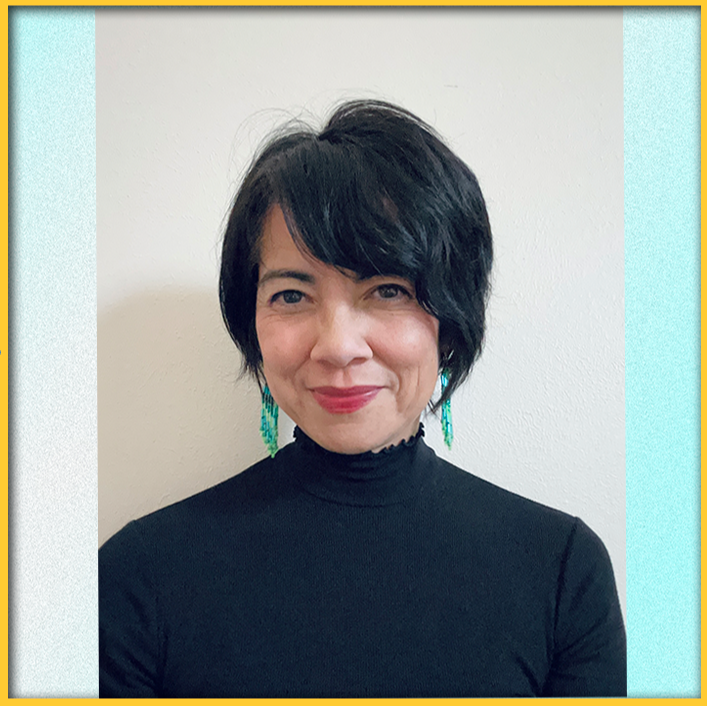
L.T. Torres is a native daughter of the American Southwest, with deep Indo-Hispanic roots in New Mexico. She has worked as an environmental professional throughout the West since 2001. Her creative non-fiction work has been published in Blue Mesa Review, Tupelo Quarterly, and is forthcoming in an anthology by Torrey House Press (2021).
RICHARD L. RUBIN
A retired physycian, Dr. Richard L. Rubin is a steward of steward of Leopold's historic home, in Tres Piedras, NM and a supporter of the modern Forest Service conservation mission following the Leopold's inspiration. He is a long-time resident of Arroyo Secco, NM, where he writes and gardens along with his educator spouse, Annette.